Monday, 12 January 2015

YEAR 3 SCIENCE - LIGHT & SHADOWS


When I was teaching full-time, I was always on the lookout for ways to engage the pupils. With changes in technology and resources, this is easier now than previously but still can prove difficult.
When it comes to Light & Shadows, I had a "wow" moment when I first saw Pilobolus do one of their shadow dance routines. This was long before Britain's Got Talent brought us Attraction.


Screenshot from Pilobolus video "Summer in the City"

I remember, as a child, making shadow shapes with my hands.
What shadow image do you think this shape might produce?
Links can also be made to:-
     - the fashion for silhouette portraits before cheap photography (1790-1840)
Beethoven as a boy - Wikipedia (public domain) 

     - Fairy Tales illustrated with silhouettes e.g. Arthur Rackham's Cinderella,
        a number of books by Jan Pienkowski and Rob Ryan

Jan Pienkowski
     - animation e.g. The Kingdom of Witches inspired by Pienkowski
                                https://www.youtube.com/watch?v=T06OToVOsbk
                              Various fairy tales by Lotte Reiniger 
                                https://www.youtube.com/watch?v=LvU55CUw5Ck   


The Adventures of Prince Achmed by Lotte Reiniger (1926)
Lotte Reiniger (1899-1981


  - Far-Eastern shadow plays
Creative Commons -The Children's Museum of Minneapolis

Back to the Science, investigations can be undertaken into "How shadows can be changed?", "How shadows change during the day?" and "Is it really cooler in the shade?".

Postscript : Thinking about Britain's Got Talent reminder me of a winner (Kseniya Simonova) of the Ukrainian version. She won with a very moving sand animation performance using a light box.
https://www.youtube.com/watch?v=HOMgDbcA84A

Saturday, 10 January 2015

PRIMARY SCIENCE - BRIDGES

PRIMARY SCIENCE : BRIDGES

The North East of England is known for its bridges crossing the Tyne, Wear & Tees. This is especially helpful when teaching about the forces involved in supporting bridges where I usually show a slide show of them.

Transporter Bridge across the River Tees
The Swing Bridge across the River Tyne


I then go on to ask "Who can build me the strongest bridge from just one sheet of A4 card /paper?". This is fun and good to video but, for me, a bit repetitive.


One of the best ever A4 card bridges - not mine.

I try for added "wow" by showing the Tacoma Bridge Disaster movie or the Top Gear look at the Millau Suspension Bridge.

What is now of particular interest to me are bridges that move and there are four in the region:-
    on the River Tees          Transporter Bridge
                                       Newport Bridge (no longer moving)
    on the River Tyne          Swing Bridge
                                       Millennium Bridge

Having got into Lego models through WeDo, having Scratch in my arsenal and having collected some K'nex, I've been trying out making interactive, moving models of these bridges.
Here's the approach:-
(a) build a working model of one of the bridges incorporating sensors and  
           motors
(b) use Scratch rather than the WeDo coding to control the bridge
(c) make the Scratch program interact with your 3D model i.e. what happens in
           real life also happens on screen.
This can prove tricky especially when it comes to weight and accurate control of the motor. 
Modelling the Swing Bridge has given me the most pleasure so far, the Transporter Bridge the most headaches.


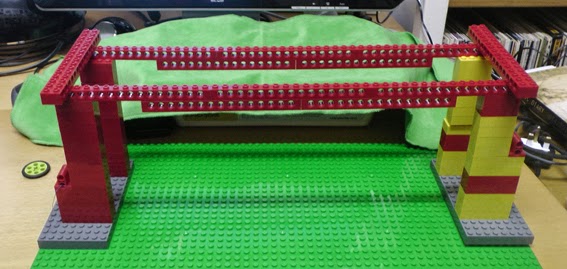
The superstructure for  my transporter bridge
I originally tried to use strong cotton to support my gondola but the gondola proved too heavy.

Here's a screenshot of my Scratch program.

My Scratch version of  the Transporter Bridge

More to follow, especially if I can get some children involved.


Year 6 SCIENCE - Evolution & Inheritance


I've pointed you towards The Phoenix Comic & Corpse Talk in past blogs. Two of the latest issues are especially relevant to the new National Curriculum. Issues 156 & 157 involve Charles Darwin and Human Evolution. 


http://www.thephoenixcomic.co.uk/shop/

What a great resource - short and simple. The team at The Phoenix deserve a pat on the back for continuing to produce a high-quality comic for children with NO ADVERTS and brilliant graphics and storylines. I'm eagerly awaiting their upcoming strip on the Universe.

If you're looking for other resources to help teach this topic look for a copy of Catalyst from 2009 (Darwin's anniversaries), The Biologist article on Alfred Russel Wallace and Primary Science review articles.


From Primary Science Review


From The Biologist 
Finally, for getting to the bottom, how about Evolution a la Simpsons.


http://www.lghs.net/ourpages/users/dburns/ScienceOnSimpsons/Clips.html


Wednesday, 7 January 2015

The blog is back.

Can't believe I've not blogged for so long. There are a hundred and one things to share and get off my chest. Preparation before publication.
But, just to whet the appetite.....

Work will centre on Scratch, Lego WeDo and building "bridges that move".

"Dementia and old age" will be a rant and "Josienne Clarke & Ben Walker" and "Lucy Ward" blogs of admiration.


"Anyone but me" is one of my favourite ever songs.
Be back soon!

Saturday, 26 October 2013

The Pleasures of WeDO

Have just completed a series of five weekly visits to a local primary school to show the children Lego's WeDo. Great fun! Lots of enthusiasm! And a lovely card at the end!
I can see many schools adopting WeDo (and I hope Scratch too) and integrating it (them) into the curriculum. That's the challenge - make the IT fit in seamlessly. 
Funny, this is how I'd begun to imagine Science would permeate primary teaching just as it (and IT) pemeate our everyday lives.
Thank you to everyone.


Friday, 6 September 2013

Aladdin's Lamp

With the Arabian Nights coming up next term, I thought I'd have no problem picking up a cheap Aladdin's lamp. I've been looking for weeks and then found a small lamp for £12.50 in a secondhand/antique shop in Morpeth.


I'm pleased with it but now have to work it into what I'd like to do - digital storytelling.

Thursday, 5 September 2013

"Brontosaurus" - another great Science read

I recently blogged about a really good Science book on the elements (The Disappearing Spoon by Sam Kean). I didn't expect to recommend another book so soon. Thanks to my wife for keeping the supply going.
The latest book is "My Beloved Brontosaurus" by Brian Switek.

Scientific American/Farrar, Strauss & Giroux (2013) ISBN 978-0-374-13506-5 
People are always telling me how children love Dinosaurs and what a good teaching topic they are. How come, in my 12 years of involvement with primary schools, I've only been asked to enthuse about dinosaurs once? 
This book not only rekindled my interest, it also brought me (almost) up-to -date with developments in the past 20-30 years that I'd missed. It was also, in my opinion, incredibly well-balanced - sensible.
It led me to looking into my library and finding these three books to recommend to you:-


Details to add

Harper Collins (2000) ISBN0-00-257012-2

Details to add
The first tells of the story of the Chicxulub impact crater and its role in the demise of the dinosaurs. The other two are by Richard Fortey, one on the fossils that grabbed him in his youth and the other an ambitious account of life on earth.